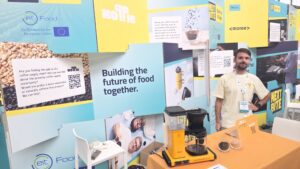
This autumn, our FoodUnfolded team had the opportunity to take part in two vibrant urban events in Zagreb: ZeGeVege and Ilica Q’art. Both gatherings created unique spaces to meet people, share ideas, and talk about food literacy and sustainability in fun and interactive ways.
ZeGeVege – Conversations with a Focused Audience
The ZeGeVege festival unfolded over two days in the very heart of Zagreb. As one of the city’s best-known events dedicated to plant-based living, it attracts a hundreds visitors eager to discover new vegan foods, innovative products, and fresh ideas. Taking place close to the central square, the festival benefits from constant foot traffic and a vibrant urban atmosphere, making it a natural hotspot for curious passersby as well as committed visitors.
At the FoodUnfolded stand, visitors were invited to take part in interactive activities. By scanning a QR code, participants unlocked a nine-piece challenge on their phones and raced to complete it as quickly as possible. By highlighting themes of food producing and food literacy, the puzzle visuals encouraged participants to learn about these topics in an engaging, playful way. The fastest solvers received a prize from local vegan food producers. Many eagerly tried again after their first round.
Our stand attracted mostly younger visitors, couples, groups of friends, and families, who were open to discussion and curious about our activities. Some chose to try out our digital puzzle, while others preferred to talk with us about food waste and sustainable choices.
Ilica Q’art – A Sunday Community Gathering
In contrast, Ilica Q’art created a relaxed and welcoming atmosphere that perfectly suited our activities. Taking place along the longest street in Zagreb, closed to traffic for the day, the event brought together artists, food producers, craft makers, and small businesses. With live music, coffee stands, and a lively crowd, it was a true community celebration.
Visitors strolled slowly from stand to stand, curious and eager to learn. Many stopped to read our banners and posters, ask questions about the project, and join in the activities. This time, people could choose between our digital puzzle or a short food waste quiz, and both options worked equally well. Younger, digitally literate participants enjoyed the puzzle challenge, while older visitors preferred answering questions about food waste, such as how much food is wasted in Croatia and what we can do to reduce it.
Why Food Literacy Matters
Bringing food literacy into these urban spaces is about raising awareness and making it visible, fun, and easy to connect to everyday choices.
Food literacy is about understanding what we eat, how food is produced, processed, stored, and shared. It enables people to make healthier decisions for themselves while also recognizing the environmental and social impacts of those choices.
Some of the facts we highlighted in conversations:
63 % of Croatian citizens say they discard food at home.
Of those, 40 % say they throw away food several times a month or more frequently.
64 % say the key reason is “too much food prepared”.
Over-purchase is also highlighted as a cause.
Food literacy skills like meal planning, creative cooking, and mindful shopping are among the most effective ways individuals can reduce waste and improve their diets.
Choosing locally produced and seasonal food supports farmers, reduces food miles, and ensures fresher, more nutritious meals.
By sharing these insights in Zagreb’s urban community spaces, we aimed to connect abstract global challenges with tangible, everyday actions.
A Step Forward
What makes ZeGeVege and Ilica Q’art so powerful was people strolling, music in the air, diverse stands, and the energy of a community coming together. In this environment, food literacy wasn’t presented as a lecture or campaign, but as an invitation: a puzzle to solve, a quiz to try, a conversation to join.
These events showed us that the city itself can be a classroom where learning happens in casual, joyful interactions, and where food literacy becomes part of the shared urban experience.