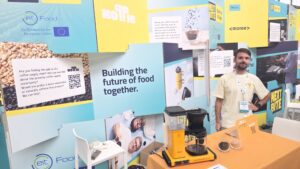

Starting with the 2025/26 school year, Croatian vocational schools are entering a new era of education: modular teaching is replacing traditional subjects. Students will no longer learn biology, chemistry, or nutrition in isolation, but through thematic units (modules) that connect knowledge and skills in the context of real life and work. The change is significant—and full of potential.
For teachers, however, this shift also means something else: more preparation, more planning, and more coordination. Every reform, no matter how meaningful, brings additional workload and the need to adapt.
That is why it is important not to start from scratch. FoodEducators comes as a ready-made solution that eases the transition, provides support, and saves valuable time.
What Is FoodEducators?
FoodEducators is a European educational program that introduces students and teachers to topics of food, sustainability, health, science, and the labor market through activities that encourage critical thinking, creativity, and stronger connections between schools and the real world.
In Croatia alone, the program has already involved more than 60 schools, 300 teachers, and 8,500 students. All materials are free of charge and partly available in the Croatian language.
What Does Modular Teaching Mean for Teachers?
The modular reform changes almost everything:
- the structure of teaching (from subjects to thematic modules),
- the planning process (teacher teams instead of individual work),
- assessment (outcome-based, through concrete tasks),
- the learning approach (less lecturing, more research and project work).
For teachers, this means:
- more time needed for preparation,
- the need to design new content,
- coordination within teaching teams,
- searching for high-quality and reliable resources.
In practice, this often means more work and greater responsibility. Many teachers ask: Where can we find good resources? How do we design projects? How do we connect vocational and general education outcomes?
FoodEducators as a Solution
FoodEducators is a practical tool for teachers, offering:
- ready-made lesson plans aligned with curricula and modular logic,
- activities for teamwork, inquiry-based and project-based learning,
- topics already aligned with cross-curricular themes,
- support through trainings, webinars, and experience exchange,
- free materials, available in Croatian and English, ready for immediate use.
For teachers working within a system in transition, this means: less stress, less searching, and more focus on what truly matters—working with students.
FoodEducators activities are not tied to a single subject or level. They enable collaboration across different teaching areas, connecting biology, chemistry, food and vocational subjects, as well as entrepreneurship, civic education, sociology, ICT, and the arts. Students therefore learn about food not only from a biological or chemical perspective, but also in terms of sustainability, economics, ethics, culture, labor markets, and technology.
Thanks to this flexibility, FoodEducators resources can be used:
- in vocational modules (nutrition, technology, hospitality),
- in general education subjects (biology, Croatian language, mathematics), through project-based and extracurricular activities (Sustainability Day, school picnic, eTwinning projects),
- as foundations for cross-curricular themes and curricula (sustainable development, health, entrepreneurship, civic education, STEM).
This means that a single well-designed module or project day can involve an entire teaching team, multiple classes, and even cooperation with the local community—using ready-made materials that save teachers time while offering students meaningful, connected learning.
How Does It Fit into Modular Teaching?
Modular teaching is based on:
- integrating multiple disciplines,
- project-based and team teaching,
- flexible organization,
- outcome-oriented, practical learning.
These principles have been at the core of the FoodEducators approach for years. Activities are designed to:
- enable collaboration across different teaching areas,
- encourage critical thinking, research, debate, and real-world solutions,
- include students of different knowledge levels through teamwork and practical tasks,
- achieve clearly defined learning outcomes (already specified in each plan).
In other words: if you are looking for content for a new module, FoodEducators probably already has it.
FoodEducators Approach and Modular Teaching
| Modular Teaching | FoodEducators Approach |
|---|---|
|
Thematic modules, integrated knowledge | Thematic units on food, environment, and health |
Thematic modules, integrated knowledge | Thematic units on food, environment, and health |
|
Outcome-based learning, practical application |
Competency-oriented activities |
|
Collaborative teacher planning |
Materials suitable for team teaching |
|
Project-based, inquiry-driven learning |
Project ideas, experiments, discussions |
|
Student-centered learning |
Students explore, create, and think critically |
What Does This Look Like in Practice?
Imagine a teaching team preparing a new module focused on food. Instead of each teacher independently designing materials and outcomes, the team uses FoodEducators resources as a shared foundation.
- Teachers jointly select an activity from the resource base aligned with the module theme (e.g. food sustainability, food technology, health).
- Everything comes ready and professionally prepared: learning outcomes, activity suggestions, worksheets, presentations, and evaluation tools.
- Students work in teams: they research, design recipes, solve problems, conduct experiments, and present solutions through posters, videos, or mini-campaigns.
- Teachers assess and guide formative learning using clearly defined criteria and jointly agreed evaluation frameworks.
Nastavnici vrednuju i vode formativno praćenje učenika kroz jasno definirane kriterije i zajednički dogovorene evaluacijske obrasce. - At the end, schools and teachers receive a FoodEducators participation certificate, confirming their active involvement in implementing activities on sustainable nutrition and education for the future.
As a result, modules are developed faster, with higher quality and stronger engagement, because the content is not only curriculum-aligned but also tested in dozens of schools across Europe and supported by a strong educator network.
Concrete Topics and Modules Where FoodEducators Helps
Below are examples of how FoodEducators resources can be directly integrated into vocational modules:
Module: Food and Nutrition (1st grade – Food Technician)
Related resources:
- “Breakfast: A Topic for Discussion”
- “Understanding Food Labels”
- “Fermentation Experiment”
- “What Does Healthy Eating Mean?”
Learning outcomes supported:
- Identify and analyze nutritional values of food
- Critically reflect on eating habits
- Compare the impact of plant-based and animal-based foods on health and the environment
Module: Food Technology (3rd grade – Food Technician)
Related resources:
- “Food in the Lab – Enzymatic Browning of Apples”
- „Fermentacija kvasca – eksperiment“
- “From a Linear to a Circular Food System”
Learning outcomes supported:
- Explain chemical changes in food
- Analyze food processes and sustainability
- Conduct and interpret simple experiments
Module: Sustainable Nutrition (gastronomy, agrotourism, ecology programs)
Related resources:
- “Food Loss and Waste – Causes and Solutions”
- “Exploring the Local Food System”
- “Regenerative vs. Conventional Agriculture”
Possible applications:
- Fieldwork and project mapping of school nutrition
- School Day or Sustainable Food Week
- Introduction to climate change through the lens of food
Module: Careers in the Food Sector (vocational and general education programs)
Related resources:
- “Guess the Agri-Food Careers Game”
- “Career Spotlight: Sensory Food Scientist”
- “Launch Your New Product – Plant-Based Milk”
Learning outcomes supported:
- Explore careers and competencies in the food sector
- Develop entrepreneurial thinking and presentation skills
- Connect STEM with the labor market through food-related examples
rada kroz prehrambene primjere
How to Get Involved
- Visit the website: www.foodeducators.eu/hr
- Register as a teacher or school
- Download materials: lesson plans, activities, worksheets, presentations
- Join trainings and the teacher community
- FoodEducators Certificate
Modular Teaching Is a Challenge—But It Doesn’t Have to Be a Burden
Reform demands more from teachers, but it also offers more space for high-quality teaching.
FoodEducators is the bridge between what modular teaching requires and what teachers can realistically deliver.
- It supports you with ready-to-use content
- It saves time
- It aligns with curricula
- It drives real change among students
romjenu kod učenika
If you want your school to implement modular teaching that is not just a new format, but a new learning experience, FoodEducators is your first step.
You can find FoodEducators teaching resources here:
https://www.foodeducators.eu/hr/resursi-hr/
For additional examples from practice, project day ideas, or support for your school team, contact the FoodEducators program coordination: foodeducators@smion.com