
Internationalization no longer looks the same as it did a few years ago. Today, as LLMs (Large Language Models) have become an integral part of business processes—from market research to customer support—expanding into foreign markets has gained a new dynamic.
However, the availability of new tools does not change a fundamental fact: internationalization is primarily a strategic decision.
Numerous studies show that a large number of organizations are already using or testing AI in their operations, yet a significant financial impact is often missing. This indicates that technology alone does not create a competitive advantage—it merely amplifies existing processes and strategy. Here is what The State of Organizations 2026 Report showed.
Below, we outline what has truly changed in the era of LLMs—and what this means for companies considering global growth.
What has changed in the era of LLMs?
LMs have significantly reduced the cost and time required to access information. Market analysis, understanding regulatory frameworks, competitor comparison, or preparing initial sales communication are now faster than ever.
Tools based on large language models can assist in:
- processing large volumes of publicly available data
- structuring market insights
- preparing localized versions of content
- testing different communication approaches
In other words, technology has lowered the operational barriers to entering new markets.
This does not mean that market research has become trivial. LLMs generate responses based on existing data, but they cannot replace primary sources, local partners, or real customers. Technology accelerates the process—but it does not make business decisions.
AI in business – reality vs expectations
- 88% of organizations use or test AI
- 81% do not see a significant financial impact
- 55% of leaders expect strong productivity growth
Currently, a large number of organizations are testing artificial intelligence, but a significant percentage of them still do not see a substantial financial impact, although they expect strong growth in productivity (and financial success) in the future.
Faster market entry, but faster competition as well
One of the biggest changes is speed. Companies can now relatively quickly adapt websites, documentation, and customer support for a new market. Content localization with the help of AI has become operationally feasible even for smaller teams.
At the same time, this same advantage is available to competitors. The global market is no longer reserved for large corporations. A startup from another country can now enter your target market almost as quickly as you can enter theirs. This phenomenon is often referred to as the “speed paradox”: technology accelerates market entry, but at the same time accelerates competition.
The consequences of the “Speed Paradox” are concrete:
- lower barriers to market entry
- a higher number of competitors
shorter periods of differentiation - faster replication of business models
Therefore, the question of internationalization today is less about the ability to enter a market, and much more about the sustainability of differentiation and positioning.
AI adoption vs real business impact
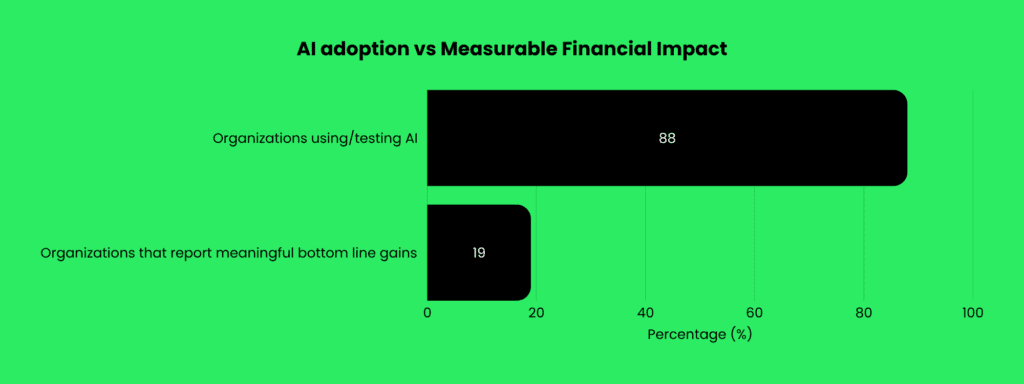
The graph shows how technology is available to everyone, but strategic implementation is not.
Localization is not the same as translation
One common misconception is that internationalization only requires translating a website and sales materials.
Today, LLMs enable higher-quality translation and tone adaptation, but localization involves much more: understanding business culture, regulatory frameworks, purchasing habits, and customer expectations.
For example, decision-making processes in the B2B segment differ from country to country. Pricing models that work in one market may not be accepted in another.
According to global studies on organizational trends, 72% of business leaders state that geopolitical and regulatory factors have already significantly impacted their operations (see sources), further emphasizing the importance of understanding the local context when entering new markets.
AI can assist in preparing analysis, but validation must come from the real business environment.
Operational readiness before technological readiness
In practice, companies often invest in AI tools before defining operational processes. However, LLMs are a multiplier of an existing system—they do not resolve structural shortcomings.
Many organizations are still developing the processes, competencies, and responsibilities required for the systematic application of AI.
Before entering a foreign market, it is necessary to clearly answer several questions:
- Do we have a scalable product?
- Can we support new users without a decline in service quality?
- Is there internal ownership for managing the new market?
Only when these foundations are in place does technology become a real advantage.
Organizational readiness for AI
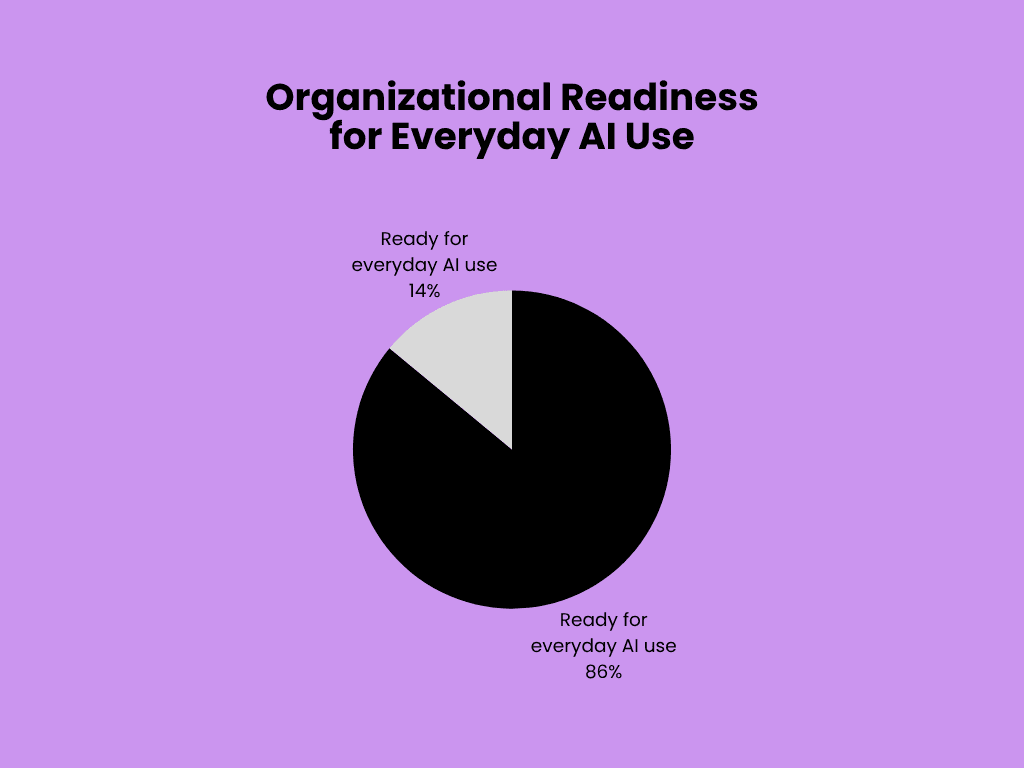
The graph illustrates the gap between technological availability and organizational readiness.
Data, but with context
LLMs can analyze trends, competitors, and regulatory information, but it is important to understand their limitations. Models operate on the data they were trained on and on the information available to them through tools. They do not guarantee completeness or accuracy of data unless it is additionally verified.
Therefore, in the process of internationalization, it is crucial to combine:
- AI analysis
- expert assessment
- local market experience
This combination reduces risk and increases the quality of decisions.
How to approach internationalization today?
Entering a foreign market in the age of LLMs requires a balance between technology and strategy.
The first step remains clearly defining the market and target segment. This is followed by validating demand—through pilot projects, partnerships, or initial sales conversations. In parallel, AI tools can support the optimization of communication, documentation, and customer support.
The key difference compared to the previous period is the speed of iteration. Today, it is possible to test, adapt, and repeat faster. However, strategic questions—market positioning, differentiation, and long-term sustainability—remain the same.
| Steps | Description of steps |
|---|---|
|
Market focus |
Identify markets with the highest potential and clearly define the target segment. |
|
Demand validation |
Test the market through pilot projects, partnerships, or initial sales conversations.
|
|
Local adaptation
|
Adapt communication, pricing models, and distribution channels to market specifics.
|
|
Operational scalability
|
Ensure the organization can support growth without compromising service quality. |
AI tools can significantly accelerate certain steps in this process—especially analysis, content preparation, and communication—but they do not replace strategic decisions.
In conclusion: LLM is not a strategy
LLMs are a powerful tool in the process of entering foreign markets, but technology itself is not an internationalization strategy.
In many organizations, the difference between AI experimentation and AI transformation is crucial. Organizations that use AI only as a tool for individual tasks often do not achieve significant business impact, while those that redesign processes around AI achieve the greatest benefits.
Sustainable international growth is the result of a combination of data, experience, and thoughtful execution.
That is why, through Startup Drill, we open topics and develop tools that support structured growth—from market validation to international readiness. We place a special focus on collaboration with organizations that work with startup teams and want to provide them with concrete, operational support in scaling to international markets.
If you are developing or managing a program that supports the growth of innovative teams and would like to see how Startup Drill can support your ecosystem, we invite you to schedule a short meeting with us.
We will gladly walk you through the approach, methodology, and collaboration opportunities.